
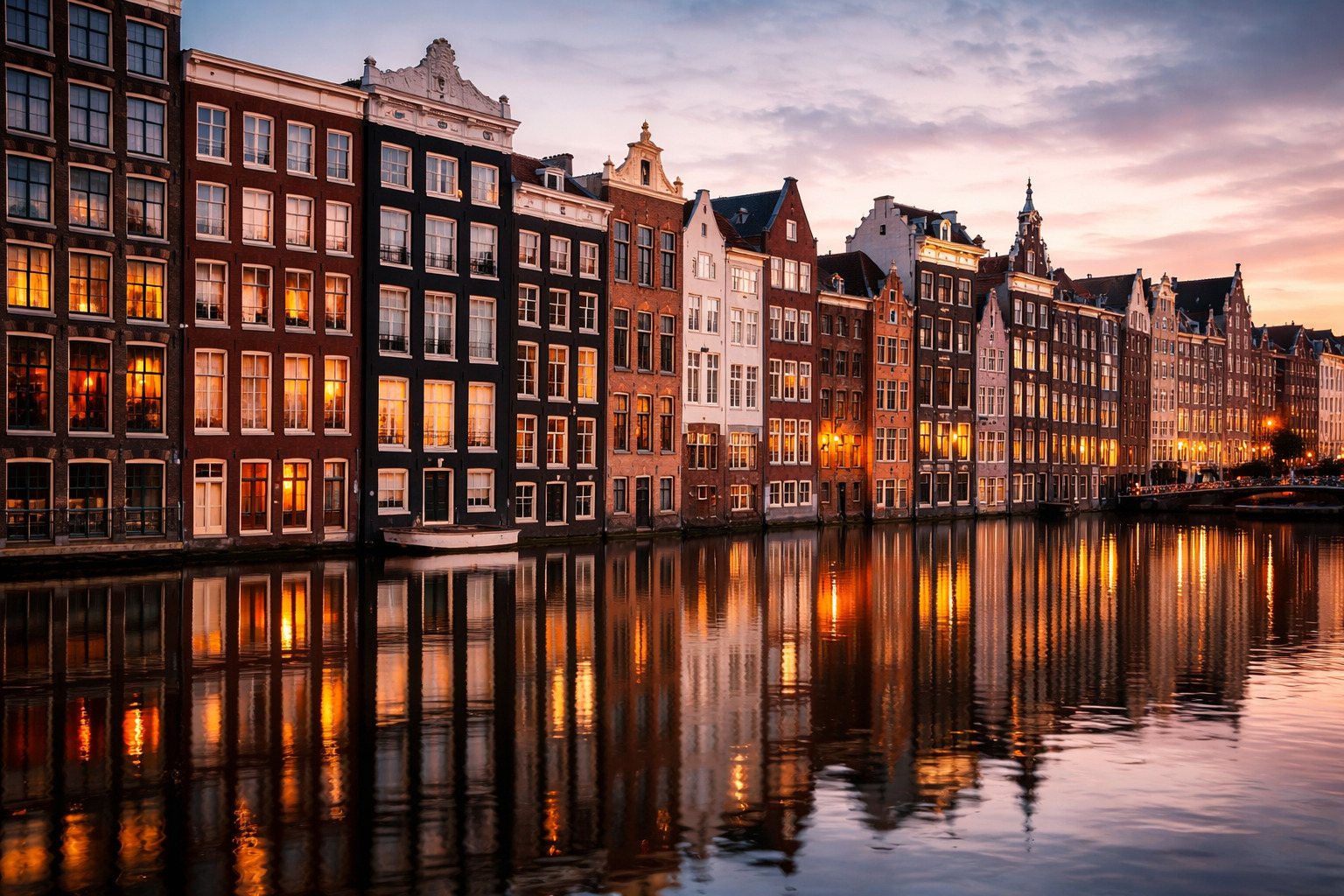
Walk out of Amsterdam Centraal Station, move just a few minutes forward, and you’ll encounter one of the most photographed views in the Netherlands. Along Damrak (1012 Amsterdam), colorful canal houses lean toward the water as if caught mid-motion. They don’t simply stand — they tilt, shift, and almost interact with each other.
This is where most people first meet the so-called “dancing houses.” But what looks like a visual illusion is actually a structural story that begins centuries earlier.
Where to See the Famous Dancing Houses (Exact Locations)
The most iconic viewpoint is located around:
Damrak 30–50, 1012 Amsterdam — the classic postcard perspective
About 500 meters from Amsterdam Centraal Station, directly along the main avenue into the city
From here, the houses line the water, creating mirror reflections that define Amsterdam’s visual identity.
For a quieter and more architectural experience, there is a second, often overlooked location:
Amstel 100–112, 1017 AD Amsterdam — known locally as the Blauwbrug dancing houses
This stretch along the Amstel River offers the same leaning façades — but without the heavy tourist flow of Damrak. It’s where the phenomenon becomes easier to observe, not just photograph.
Why Amsterdam’s Houses Lean at All
The explanation starts beneath the city.
Amsterdam was built on peat and marshland, not solid ground. From its earliest development, the city relied on engineering rather than geography. Buildings were constructed on wooden piles driven deep into wet soil, a technique dating back to the 17th century during the Dutch Golden Age .
These foundations worked — but only under one condition: constant water.
When water levels remain stable, the wood is preserved. When they drop, oxygen reaches the piles, causing decay. Over time, some supports weakened faster than others, leading to uneven settling.
The result:
houses leaning sideways
façades tilting forward
entire rows appearing to “move” together
What looks playful today is actually the visible trace of structural compromise over centuries.
When Architecture Was Meant to Lean
Not all tilts in Amsterdam are structural accidents. A significant part of the “lean” was intentional — embedded in the logic of a trading city at its peak.
In the 17th century, Amsterdam’s canal houses were built under spatial and economic pressure. Plots were narrow, taxation was tied to façade width, and vertical expansion became the only viable model. These buildings functioned as compact logistical systems, where storage, trade, and living coexisted within constrained volumes.
Cargo circulation followed the same logic. Moving goods through tight staircases was impractical, so external lifting became standard. Iron hooks, still visible on many façades, supported pulley systems that transferred goods directly to upper levels.
A perfectly vertical façade created friction — literal and operational. Suspended cargo would collide with the wall during lifting. The architectural response was precise: a controlled forward inclination, calculated to create clearance without compromising stability.
This was not aesthetic deviation, but mechanical necessity translated into form.
What is now perceived as irregularity originates in calibrated design. Over time, this initial tilt was amplified by uneven subsidence of wooden pile foundations, especially under fluctuating groundwater conditions.
The result is not a singular cause, but a layered condition: engineered inclination intersecting with geological instability.
Why Amsterdam’s Houses Lean at All
The explanation starts beneath the city.
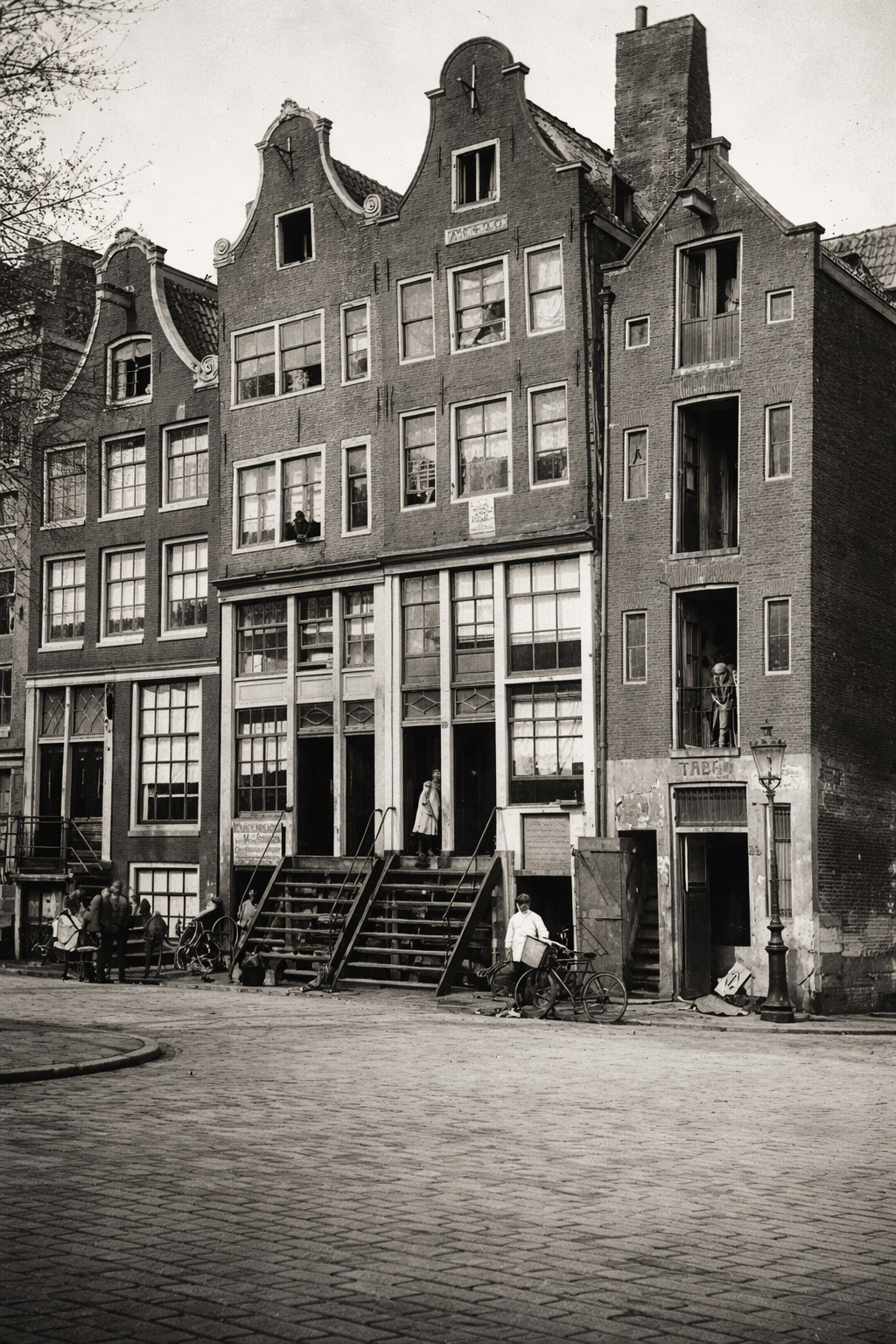
Amsterdam was built on peat and marshland, not solid ground. From its earliest development, the city relied on engineering rather than geography. Buildings were constructed on wooden piles driven deep into wet soil, a technique dating back to the 17th century during the Dutch Golden Age .
These foundations worked — but only under one condition: constant water.
When water levels remain stable, the wood is preserved. When they drop, oxygen reaches the piles, causing decay. Over time, some supports weakened faster than others, leading to uneven settling.
The result:
houses leaning sideways
façades tilting forward
entire rows appearing to “move” together
What looks playful today is actually the visible trace of structural compromise over centuries.
A City Built on Trade, Not Space
To understand the form, you have to understand the pressure behind it.
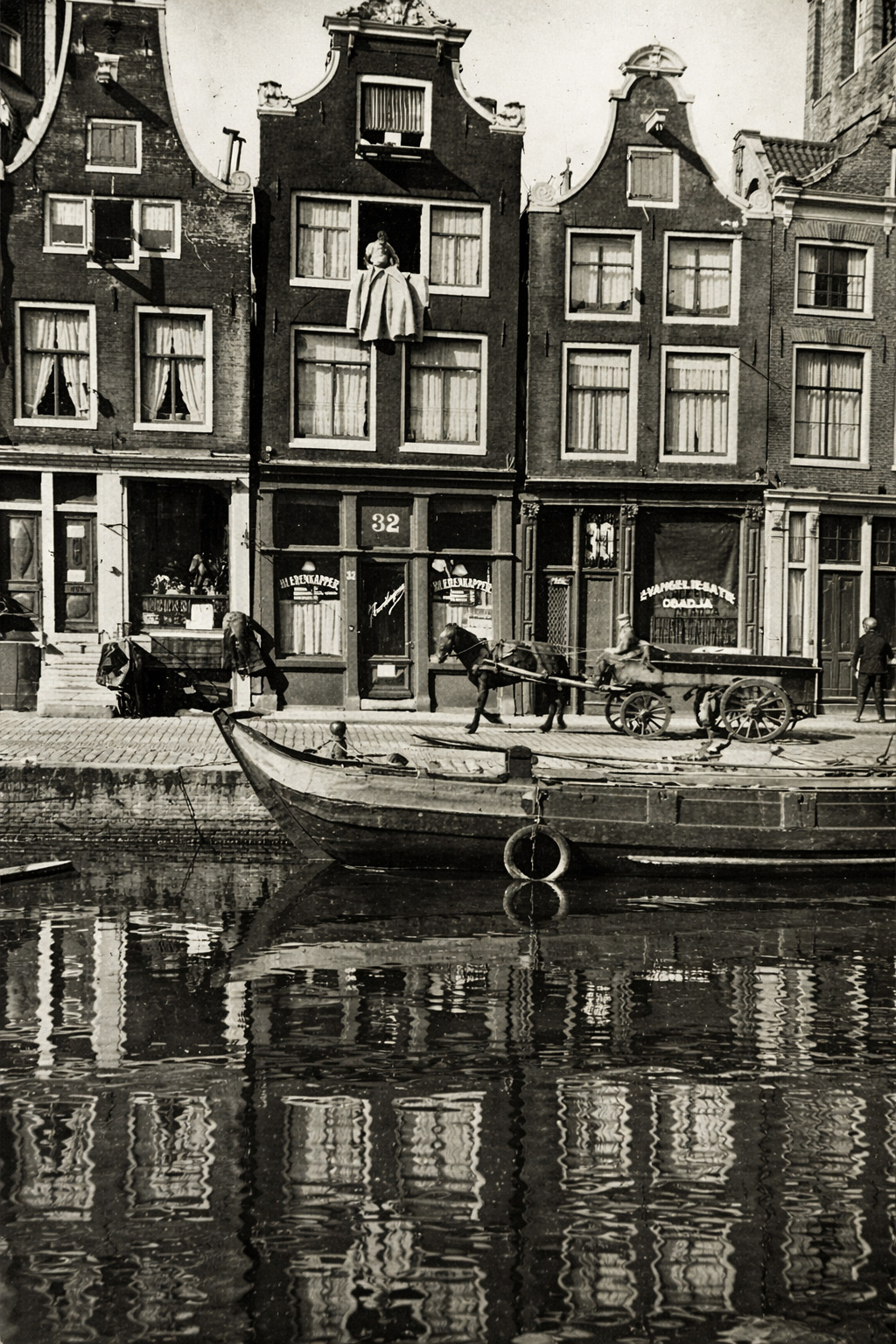
In the 17th century, Amsterdam became one of Europe’s most important commercial hubs. The city expanded rapidly, but space remained limited. Property taxes were calculated based on the width of the façade, not the depth.
So the solution was simple:
build narrow
build tall
These houses were vertical systems:
ground floor → storage or shop
upper floors → living space
attic → goods storage
They were efficient, compressed, and economically optimized.
The result is the signature Amsterdam silhouette — and the reason why even today some houses are just over two meters wide.
Why Damrak Became the Icon
Damrak itself is not just a street — it is historically the former mouth of the Amstel River, later partially filled and transformed into the main urban axis between the station and Dam Square .
It functions as:
the first visual contact with the city
a transition between transport and historic center
a symbolic “entry corridor” into Amsterdam
That is why the dancing houses here became iconic. They are not hidden — they are positioned exactly where the city introduces itself.
When to See Them (and Why Timing Changes Everything)
Light defines the experience more than location.
Early morning (7–9 AM) → calm water, minimal crowds
Golden hour → warm tones, enhanced textures
Blue hour → reflections + city lights = cinematic effect
At Damrak, patience matters. A few minutes without movement can completely transform the frame.
Three Details Most Visitors Miss
Some houses lean up to 5 degrees or more, making the effect more noticeable than expected.
Water level fluctuations still influence structural stability today — the system is ongoing, not historical.
Despite their appearance, these buildings are actively maintained and remain fully functional.
More Than a Visual Curiosity
It’s easy to treat the dancing houses as a photo opportunity. But they reveal something deeper about Amsterdam.
This is a city that did not resist its environment — it adapted to it.
Built on water, constrained by space, driven by trade — its architecture reflects negotiation rather than control. Nothing is perfectly straight, but everything still works.
A Final Perspective
Amsterdam is not defined by symmetry, but by adjustment.
The leaning houses are not imperfections — they are engineered responses, later shaped by time and ground.
What looks unstable is, in fact, sustained balance.
Explore more Amsterdam insights.