
Magere Brug in Amsterdam and Why It Remains the City’s Most Iconic Bridge
In a city defined by water, bridges are everywhere. But one of them stands apart — not by size or engineering complexity, but by proportion, light, and position.
The Magere Brug, known as the “Skinny Bridge,” crosses the Amstel River in the center of Amsterdam. Its simplicity is exactly what makes it distinct.
Location and Access
Address:
Amstel 81, 1018 EK Amsterdam, Netherlands
The bridge connects both sides of the Amstel between key areas of the historic center, within walking distance of Rembrandtplein and Waterlooplein. Despite its central location, it remains relatively calm compared to other landmarks.
Why This Bridge Stands Out
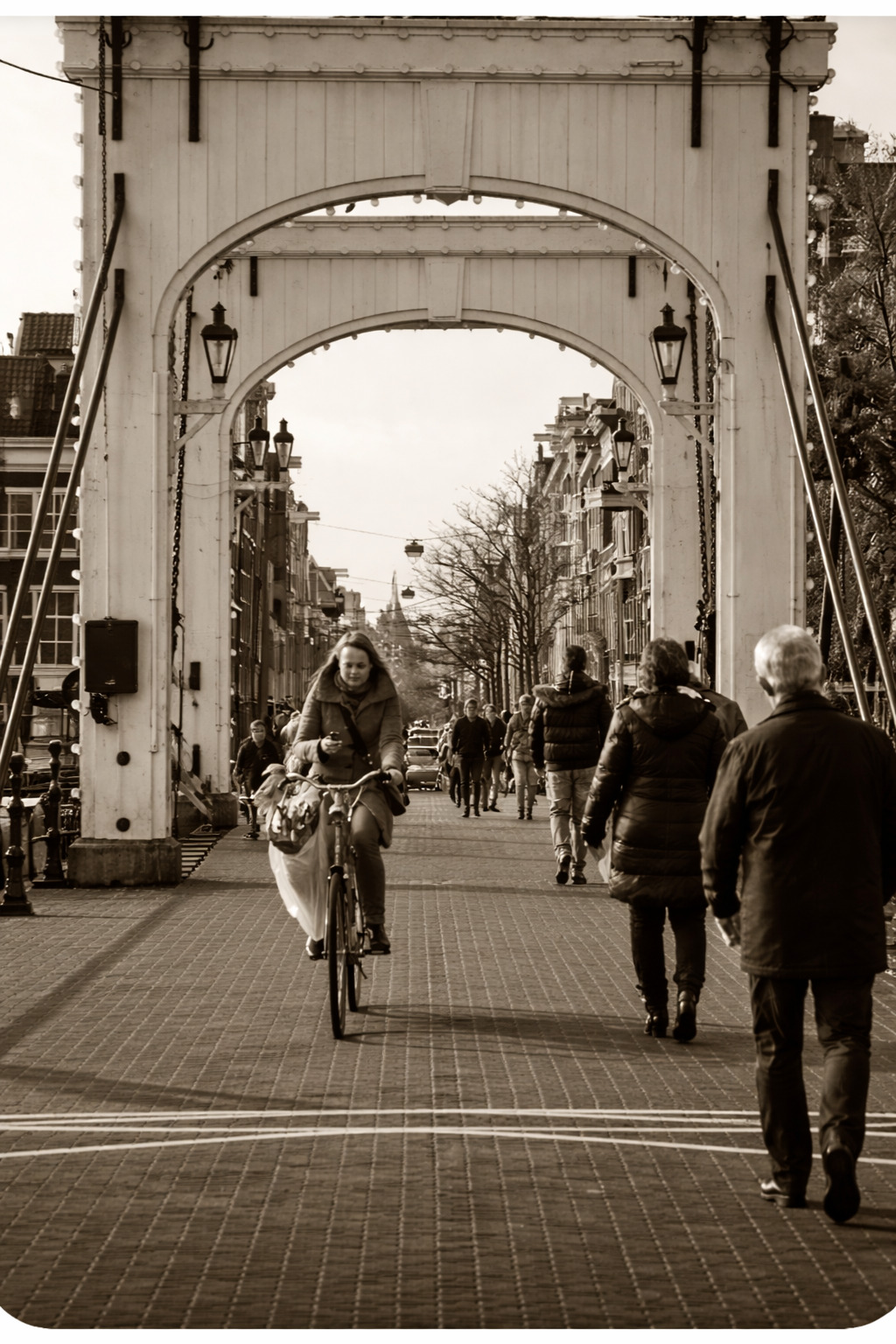
Magere Brug is a traditional double-leaf wooden drawbridge. Unlike most bridges in Amsterdam, which are stone or steel, this one preserves a lighter, almost minimal structure.
Its proportions are deliberate:
narrow passage
symmetrical arms
clean white wood construction
The result is not monumental — but precise.
The current version dates to the 20th century, replacing earlier structures while maintaining the original form. Historically, the bridge had to be wide enough for pedestrians, but light enough to open frequently for river traffic.
Function Before Aesthetic
The bridge was engineered as a moving element within the city’s water network — not a static crossing, but part of a system designed to accommodate continuous river traffic.
Magere Brug is a double-leaf bascule bridge, meaning it opens in two symmetrical sections to allow larger vessels to pass along the Amstel. This function was essential in a city where waterways operated as primary transport routes for goods and materials.
Historically, the mechanism was entirely manual. Bridge keepers operated a chain-and-winch system, lifting both halves in coordination. Timing was critical: uneven movement could destabilize the structure or interrupt passing traffic. The process was physically demanding and required constant presence, as the bridge opened multiple times a day.
In the 20th century, the system was replaced with electrical motors and automated controls, significantly increasing precision and safety. The opening sequence became smoother, faster, and less dependent on manual labor — but the principle remained unchanged.
Today, the bridge still lifts regularly, preserving its original function within a modernized system.
What appears as a quiet architectural object is, in reality, an active mechanism — one that continues to operate according to the same logic it was built for.
The Role of Light
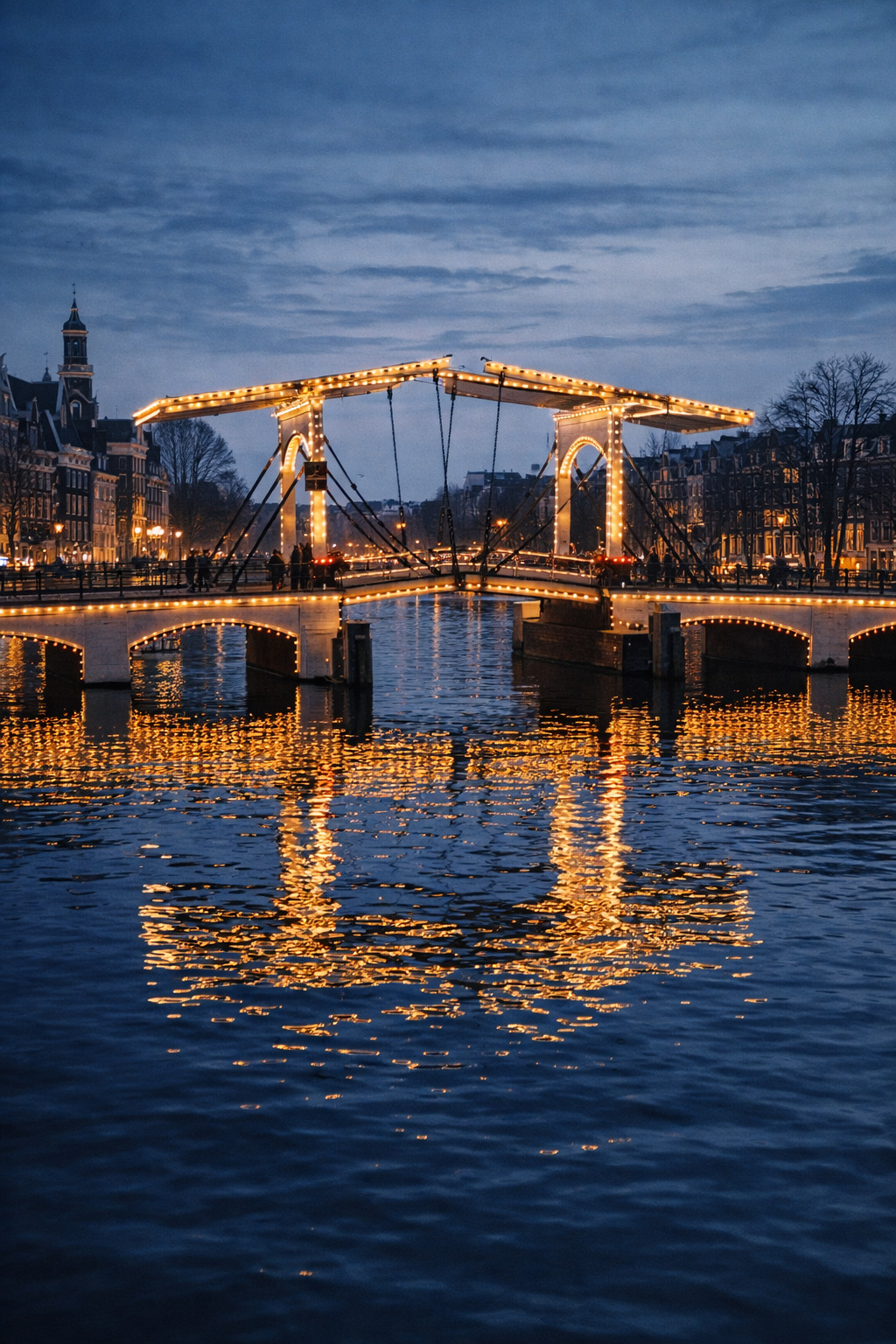
Magere Brug changes completely after sunset.
The structure is outlined by hundreds of small lights, evenly distributed along its frame. Reflected in the Amstel, they create a precise, almost mirrored composition.
Best times to visit:
early morning → minimal activity, clean lines
golden hour → soft contrast on white wood
after sunset → full illumination and reflections
Unlike Damrak, the effect here is quieter, more controlled.
The Story Behind the Name
“Magere Brug” translates directly as “Skinny Bridge.”
According to local legend, two sisters living on opposite sides of the river financed the bridge to stay connected. While the historical accuracy is uncertain, the name reflects the original narrow design.
The bridge was later widened, but the name remained.
A Persistent Detail in the City’s Structure
Magere Brug appears frequently in film and photography, not because of its scale, but because of its precision. It functions as a visual shorthand for Amsterdam — controlled, minimal, and immediately recognizable.
Few structures in the city make their logic so visible:
movement is not hidden, mechanics are not decorative, and proportion defines the entire experience.
A Final Note
Amsterdam’s infrastructure is built out of necessity, not spectacle.
Magere Brug stands as one of the clearest examples where engineering, rhythm, and restraint align without excess. Nothing about it is amplified — and that is exactly why it works.
It does not compete for attention.
It structures the view.
Explore more Amsterdam insights